

Table of Contents
It was July 4, 2022. My co-founder Gabe and I were in our San Francisco apartment, still living on a mattress on the floor, when we dialed into a video call with the entire C-suite of OpenAI. We had cold-emailed them two weeks earlier with nothing but a rough demo and an audacious 86% accuracy claim on a Reddit legal advice test. They didn’t laugh us off the line. Instead, Sam Altman and his team agreed to meet on a national holiday. That moment felt like a strange, quiet inflection point—the legal industry was about to shift, and we had somehow secured a front-row seat to the future of the legal AI operating system reshaping the industry.
Two years later, that casual July Fourth call had evolved into a fundamental transformation of how legal work gets done. By early 2025, Harvey had surpassed $50 million in annual recurring revenue, expanded to 235 customers across 42 countries, and locked in the majority of the top 10 U.S. law firms as clients. Today, over 100,000 lawyers across more than 1,000 organizations globally run their most critical work through our platform. We didn’t just build another legal tech tool; we built the underlying operating system for how AI and law will coexist.
Founding Story
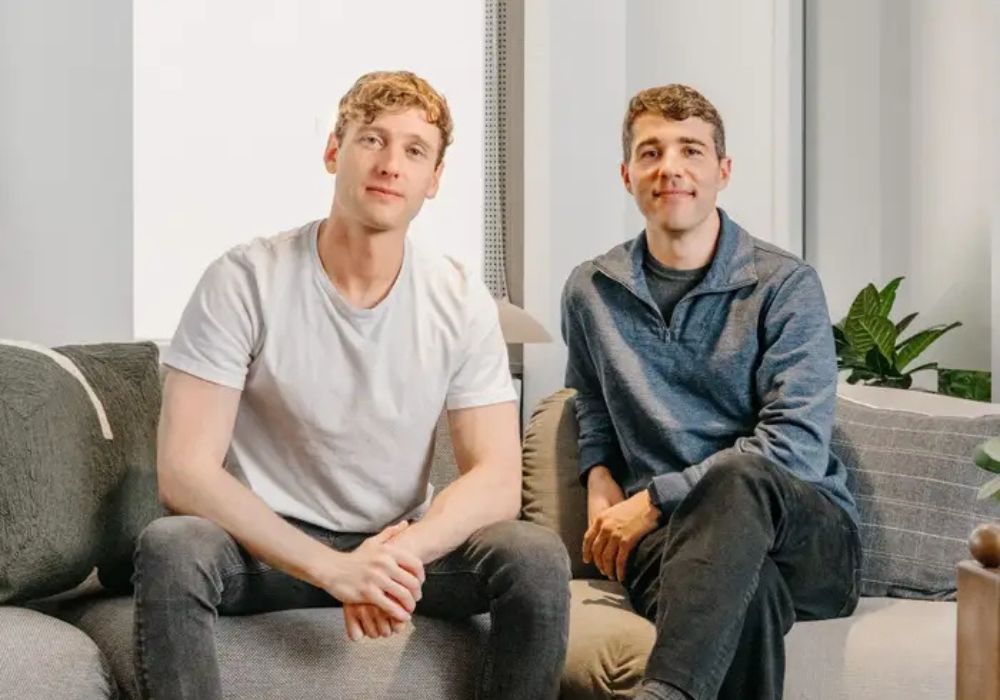
The spark ignited in 2021 in a Los Angeles apartment where two roommates shared drastically different professional worlds. Winston Weinberg was grinding through 80-hour weeks as a first-year securities and antitrust litigator at O’Melveny & Myers. He had graduated from USC Law and quickly realized that much of what junior associates did—picking apart thousand-page documents, sifting through millions of emails for litigation—was work they could have done even before law school. Across the living room, Gabriel Pereyra was a research scientist who had worked on large language models at Google DeepMind and Meta.
One evening, Gabe showed Winston OpenAI’s GPT-3 text-generating system. The realization hit instantly: what if AI could automate the tedious, rote legal tasks that consumed associates’ lives, freeing them to focus on crafting thoughtful arguments for their clients?
“I only practiced law for a little less than a year, and I realized that a lot of the work that associates are doing is work that they could have done even before law school.”
— Winston Weinberg, Forbes interview
The two roommates built a crude prototype in a matter of months. They pulled 100 legal questions from Reddit’s r/legaladvice forum, focusing on California tenant law, and used GPT-3 to generate answers. Then they did something unconventional: they hired three practicing attorneys to evaluate whether each answer could be sent to a client unchanged.
The result? Eighty-six out of 100 answers were approved.
With that proof of concept, they cold-emailed OpenAI, addressing the message specifically to Jason Kwon, the company’s general counsel, knowing that a lawyer would best understand the quality of their outputs. The email led to the July Fourth 2022 meeting with OpenAI’s executive team. OpenAI became Harvey’s seed investor and granted the founders early access to GPT-4 before it was publicly released—a significant competitive advantage.
The company officially launched in November 2022, named after Harvey Specter, the charismatic lead character from the legal drama Suits, a show that had made the legal profession feel aspirational to a generation.
Early Challenges:
(Reconstructed sentiment based on multiple founder interviews) “Getting anyone to take us seriously was the hardest part. We were two nobodies—a first-year associate who hadn’t even made it through his first full year of practice and an AI researcher who had spent years behind the scenes at Google. Law firms don’t take chances on nobodies.”
The founders faced the classic startup Catch-22: major law firms wouldn’t trust an unproven AI product, but they needed those firms to validate their technology. They solved it through sheer tenacity, sending thousands of LinkedIn cold messages and crafting personalized demonstrations for each target client. For one pitch, Winston took a recent public filing from a potential client, generated counter-arguments using Harvey’s model, and presented them as a live demo. The personalized approach worked, and once they secured trust from one or two industry giants, the floodgates opened.
Funding Timeline:
| Date | Round | Amount | Lead Investors | Valuation |
|---|---|---|---|---|
| Nov 2022 | Seed | $5M | OpenAI Startup Fund, Jeff Dean, Elad Gil, Sarah Guo | N/A |
| Apr 2023 | Series A | $21M | Sequoia Capital | N/A |
| Dec 2023 | Series B | $80M | Elad Gil, Kleiner Perkins | $715M |
| Jul 2024 | Series C | $100M | Google Ventures, Kleiner Perkins, Sequoia, Elad Gil | $1.5B |
| Feb 2025 | Series D | $300M | Sequoia Capital | $3B |
| Jun 2025 | Series E | $300M | N/A | N/A |
| Dec 2025 | Series F | $160M | Andreessen Horowitz | $8B |
| Mar 2026 | Series G | $200M | GIC, Sequoia Capital | $11B |
By March 2026, Harvey had raised over $1 billion in total funding, with Sequoia co-leading its third round for the same company—a rare occurrence that underscored the firm’s conviction.
Target Audience Shift: From AI Tool to Enterprise Legal AI Platform
Initial Target Audience:
The founders initially targeted individual lawyers and small legal teams, building an AI assistant that could handle document analysis, research, and drafting. The early product was relatively simple: a chatbot that could answer legal questions in natural language.
Refined Audience:
After landing Allen & Overy and PwC as early clients, Harvey pivoted dramatically. Instead of selling to individual lawyers, the company began targeting enterprise legal departments and global law firms. The refined audience became:
- AmLaw 100 law firms: Harvey now counts 45 of the AmLaw 100 as customers
- Global law firms: Allen & Overy, A&O Shearman, Macfarlanes, ReedSmith, O’Melveny & Myers, Vinson & Elkins, Gleiss Lutz
- Multinational corporations: PwC (4,000 legal professionals across 100 countries), Bayer, Deutsche Telekom, Comcast, KKR, HSBC, NBCUniversal
- In-house legal departments: Corporate legal teams at major enterprises
Competitive Positioning in the Legal AI Industry:
| Competitor | Positioning | Harvey’s Differentiation |
|---|---|---|
| Casetext CoCounsel (Thomson Reuters) | Versatile AI assistant for litigation and drafting | Deeper enterprise customization, agent-based workflows |
| Lexis+ AI | Research-focused, integrated with LexisNexis content | Custom-trained case law model, strategic partnership with LexisNexis |
| Eve (a16z-backed) | Legal AI for solo and small firms | Enterprise scale, 100,000+ lawyer user base |
| Spellbook | Drafting-focused for transactional lawyers | Full legal workflow coverage (research, drafting, review, compliance) |
| Robin AI | Contract review and editing | Comprehensive legal AI platform with agent-based architecture |
| LawGeex/Kira Systems | Contract review only | Domain-specific AI for complex legal reasoning, not just pattern matching |
What Makes Harvey a Leading Legal AI Operating System:
- Custom-Trained Legal Models: Harvey partnered with OpenAI to build a custom-trained case law model, adding the equivalent of 10 billion tokens worth of legal data, starting with Delaware case law and expanding to all U.S. case law. In side-by-side testing with 10 of the largest law firms, the custom model outperformed GPT-4 in 97% of evaluations.
- Lawyer-Driven Product Development: Over 20% of Harvey’s employees are former lawyers from top firms including White & Case, Latham & Watkins, Skadden, Gunderson Dettmer, Katten Muchin Rosenman, and Paul Weiss. These lawyers work directly alongside engineers, explaining legal workflows in granular detail to ensure the AI produces outputs that match professional standards.
- Agent-Based Architecture: Harvey transitioned from a simple chatbot to a fully agentic framework in 2025, enabling AI to proactively plan, create, and execute end-to-end legal tasks on behalf of customers—from making multiple retrieval requests to specialized databases to dynamically pulling information to address difficult sections in long drafts.
- Multi-Model Agnosticism: Harvey runs on OpenAI, Anthropic, Gemini, Mistral, and Xai simultaneously—not vendor lock-in, but model agnosticism that optimizes different legal tasks with the best-performing models.
- Strategic Data Partnerships: A 2025 alliance with LexisNexis gave Harvey access to Shepardized case law and primary content directly within its platform, locking in a crucial data advantage.
- Benchmark-Leading Performance: In the first independent legal AI benchmark study by Vals AI, Harvey received top scores among participating AI tools on five out of six tasks evaluated and outperformed human lawyers on four tasks.
Marketing Platforms & Strategies
Priority Platforms:
- Direct Enterprise Sales: The primary channel. Harvey’s sales team consists largely of former Big Law attorneys who understand the trust barriers and procurement processes of law firms.
- LinkedIn: Used extensively for outreach to legal decision-makers. Winston Weinberg sent thousands of personalized LinkedIn messages in the early days.
- Forbes/CNBC/Fortune: Strategic media placements to build credibility. Weinberg was named to Forbes 30 Under 30 in 2024.
- LawNext Podcast and Legal Tech Conferences: Industry-specific channels to reach legal professionals.
- Customer Advisory Board: Launched in March 2026 with legal heads from HSBC, NBCUniversal, and Dentsu Group to provide strategic guidance and generate case study material.
Types of Content That Worked Best:
- Transparent, data-backed performance claims: Sharing the 86% accuracy result from the early Reddit test, the 97% preference for Harvey’s custom model over GPT-4, and independent benchmark results.
- Lawyer-led product narratives: Having former practicing attorneys explain how Harvey solves specific pain points they personally experienced.
- Customer case studies: Allen & Overy deploying Harvey to 3,500 lawyers; PwC rolling it out to 4,000 legal professionals across 100 countries.
Two Fully Documented Campaigns
Campaign 1: “The Reddit Proof Point”
- Goal: Validate product-market fit and attract seed investment
- Creative: Pull 100 legal questions from r/legaladvice, generate answers using GPT-3, have three attorneys evaluate each answer for client-readiness
- Spend: Essentially zero—just the founders’ time
- Result: 86/100 answers approved as client-ready; cold email to OpenAI led to July 4 meeting and seed investment
- CVR: Not publicly verifiable; qualitative validation
- CAC: N/A
- Outcome: Secured $5M seed round from OpenAI Startup Fund
Campaign 2: “The Personalized Demo for Allen & Overy”
- Goal: Land first major enterprise client
- Creative: Take a recent public filing from a potential client, use Harvey to generate counter-arguments and legal strategies, present as live demonstration
- Spend: Minimal—founders’ time
- Result: Allen & Overy became first major client, deploying Harvey to 3,500 lawyers and staff
- CTR: Not applicable (direct sales)
- CVR: Closed the deal
- CAC: Not publicly verifiable
- Outcome: PwC followed shortly after, deploying to 4,000 legal professionals
“To acquire such customers, Weinberg says he found the most recent public legal document that a potential client filed and generated potential counter-arguments that could be used against them in court using Harvey’s model. The personalized approach worked—and it only took the trust of one or two big names to get the ball rolling.”
— Forbes
One Failed Campaign with Lessons
Campaign: Attempt to market Harvey as a general-purpose chatbot for individual lawyers before the enterprise pivot
Why It Failed: The product was too generic. Lawyers didn’t trust a simple chatbot for complex legal work. Legal work requires deep context, jurisdictional nuance, and verified citations—things a basic LLM couldn’t reliably provide without customization.
Lesson Learned:
“Legal work is incredibly complex and requires so much context, that a simple chatbot doesn’t work.”
— Winston Weinberg, Fortune interview
The failure forced Harvey to pivot from a “better chatbot” narrative to an “enterprise legal AI platform” narrative, investing heavily in custom training, lawyer-led development, and workflow-specific features.
Technology & Analytics Stack
Core Technology:
| Component | Description |
|---|---|
| Foundation Models | OpenAI GPT-4 family (primary), Anthropic Claude, Google Gemini, Mistral, Xai |
| Custom Training | Partnership with OpenAI for 10B token case law model |
| Architecture | Agent-based framework using OpenAI Agent SDK |
| Orchestration | Tool Bundles for modular capabilities, eval gates with leave-one-out validation |
| Retrieval | RAG architecture with multi-source retrieval (LexisNexis, customer Vaults, public databases) |
| Infrastructure | Multi-region data hosting (EU, US, Australia) |
Product Modules:
- Assistant: Document analysis, drafting, conversational AI
- Vault: Document storage and management
- Knowledge: Legal research with citation verification
- Workflows: Custom legal process automation
Analytics & KPIs Tracked:
- Weekly active users (quadrupled in 2024-2025)
- Customer adoption rate (exceeding 90% within client firms)
- Accuracy scores per task (per Vals benchmark: Document Q&A 94.8%, Chronology Generation 80.2%)
- ARR growth rate
- Customer expansion metrics (“most accounts grow pretty massively” – Weinberg to CNBC)
Security & Compliance:
- SOC 2 Type II
- ISO 27001
- GDPR and CCPA compliance
- Enterprise-grade data isolation and ethical walls for law firms
Growth Timeline of a Legal AI Operating System
Text-Based Timeline:
2021 (Early)
Winston and Gabe, as roommates, begin prototyping
2022 (Summer)
July 4: Meeting with OpenAI C-suite
November: Harvey publicly launches
2023
February: Allen & Overy becomes first major client (3,500 lawyers)
March: PwC becomes second major client (4,000 legal professionals)
April: $21M Series A led by Sequoia
July: Gordon Moodie (Wachtell partner) joins as CPO
September: Macfarlanes partnership announced
December: $80M Series B led by Elad Gil & Kleiner Perkins ($715M valuation)
2024
Early: 82 employees, plans to double
July: $100M Series C led by Google Ventures ($1.5B valuation)
Year-end: 235 customers across 42 countries
Revenue: $65.8M ARR (558% YoY growth)
2025
February: $300M Series D led by Sequoia ($3B valuation); $50M ARR surpassed
April: $75M ARR
June: $300M Series E
August: $100M ARR crossed (36 months from launch)
October: €50M from EQT Growth for international expansion
December: $160M Series F led by Andreessen Horowitz ($8B valuation)
Year-end: 500+ customers across 53 countries; 500+ employees
2026 (Through March)
January: 1,000+ customers across 59 countries; 500+ employees; $195M ARR
February: Singapore office opening announced; Dublin office opened
March: $200M Series G co-led by GIC & Sequoia ($11B valuation)
March: Keith Enright (Gibson Dunn AI co-chair) joins as Chief Strategy Officer
March: Inaugural in-house customer advisory board launched (HSBC, NBCUniversal, Dentsu)
Planned: Paris office opening (Q2)
Key Partnerships & Innovations:
- OpenAI: Custom-trained case law model, early access to GPT-4, seed investment
- LexisNexis: Strategic alliance for Shepardized case law and primary content
- iManage & Wolters Kluwer: Integration partnerships for legal tech ecosystem
- EQT Growth: €50M investment for European and Asian expansion
- Gabriel Macht (actor who played Harvey Specter): First brand partnership to launch Instagram page (February 2026)
Challenges in Building AI for the Legal Industry
Challenge 1: The Trust Deficit
In the early days, law firms were deeply skeptical of AI. The industry had seen overhyped legal tech products fail before, and the consequences of AI errors in legal work could be catastrophic—malpractice, sanctions, lost cases.
(Reconstructed quote based on multiple interviews) “The biggest thing with AI is going to be trust, and earning the trust of those larger institutions early on is crucial given we’re helping these folks with extremely high-profile work.”
— Winston Weinberg, Forbes
Recovery: Harvey hired former Big Law attorneys to lead sales and product development, providing peer-level credibility. The company also invested heavily in citation verification and transparent performance metrics.
Challenge 2: The General-Purpose Chatbot Trap
Initially, Harvey’s product was too similar to generic LLM interfaces. Lawyers didn’t find it useful because it lacked legal-specific workflows, jurisdictional awareness, and reliable citation verification.
Recovery: The company pivoted to building domain-specific features: custom-trained case law models, document review tables, redlining capabilities, and agent-based workflows that could handle multi-step legal tasks.
Challenge 3: Scaling Without Breaking Security
As Harvey grew from a handful of customers to 1,000+ across 59 countries, maintaining data isolation and ethical walls for competing law firms became exponentially harder. Law firms demanded absolute guarantees that their confidential work product would never be exposed to competitors using the same platform.
Recovery: Harvey invested heavily in multi-tenant architecture with strict data partitioning, achieved SOC 2 Type II and ISO 27001 certifications, and offered regional data hosting (EU, US, Australia) to satisfy local data sovereignty requirements.
Challenge 4: The Hallucination Problem
Early versions of Harvey, like all LLM-based products, occasionally generated plausible-sounding but incorrect legal information—a non-starter in a profession where accuracy is literally a matter of liberty and financial survival.
Recovery: Harvey partnered with OpenAI to build a custom-trained case law model focused specifically on reducing hallucinations. They added 10 billion tokens of legal data, implemented a robust citation engine, and created evaluation frameworks to catch errors before they reached users.
Challenge 5: Competition Intensifies
By 2025, the legal AI space had become crowded: Thomson Reuters acquired Casetext, LexisNexis launched Lexis+ AI, Eve raised $47 million from a16z, and Robin AI secured $25 million. Each competitor had a slightly different angle.
Recovery: Harvey leaned into its strategic advantages: the custom-trained model with OpenAI, the lawyer-heavy workforce, and the LexisNexis data partnership. The company also shifted from “AI assistant” positioning to “essential infrastructure for legal work.”
“AI isn’t just assisting lawyers. It’s becoming the system through which legal work gets done.”
— Winston Weinberg, March 2026
How Harvey Became a Global Legal AI Brand
Harvey became a household name not through traditional PR stunts but through a combination of strategic milestones that made the brand synonymous with legal AI.
The Early Client Coup: Landing Allen & Overy and PwC as its first two customers sent a powerful signal to the legal industry. If the world’s largest law firm and the world’s largest professional services firm trusted Harvey, others had to pay attention.
The Forbes 30 Under 30 Recognition (2024): Winston Weinberg’s inclusion in Forbes 30 Under 30 put a human face on the company and generated widespread media attention.
The Valuation Narrative: Harvey’s rapid ascent from $715M to $11B in just over two years became a compelling story about the transformative potential of AI in professional services. Each funding round generated headlines: “$100M Series C,” “$300M Series D,” “$160M Series F,” “$200M Series G.”
The “Suits” Connection: Naming the company after Harvey Specter from Suits gave Harvey instant cultural recognition within the legal profession. In February 2026, the company brought the connection full circle by announcing its first brand partnership with Gabriel Macht, the actor who portrayed Harvey Specter, to launch Harvey’s Instagram page.
The New York Times Profile: The founders were featured in The New York Times as “AI billionaires who still sleep on a mattress on the floor,” a humanizing narrative that contrasted their humble beginnings with their astronomical success.
Customer Advisory Board (March 2026): Launching an advisory board with legal heads from HSBC, NBCUniversal, and Dentsu Group positioned Harvey as a mature enterprise partner, not a startup experiment.
Long-Term Customer Loyalty Strategy:
- Adoption rates exceeding 90% within client firms, indicating deep product integration
- Lawyer-driven product development ensures features match real workflows
- Transparent benchmark results (Vals study) build credibility
- Strategic data partnerships lock in content advantages
- Agent-based architecture increases switching costs as customers build custom workflows
Financial Growth of a Legal AI Operating System
Revenue Milestones:
| Period | ARR | Growth Rate |
|---|---|---|
| End of 2023 | $10M | — |
| End of 2024 | $65.8M | 558% YoY |
| April 2025 | $75M | 50% from Dec 2024 |
| August 2025 | $100M | 36 months from launch |
| End of 2025 | $195M | 290% YoY |
Customer Growth:
- End of 2024: 235 customers across 42 countries, majority of top 10 U.S. law firms
- End of 2025: 500+ customers across 53 countries
- March 2026: 1,000+ customers across 59 countries, 45 of AmLaw 100 firms
User Base: Over 100,000 lawyers run their most critical work on Harvey (as of March 2026).
Unit Economics (Not Publicly Verifiable):
- Customer Acquisition Cost (CAC): Not publicly disclosed
- Customer Lifetime Value (LTV): Not publicly disclosed
- Gross Margin: Not publicly disclosed
- Net Revenue Retention: Implied to be high (“most accounts grow pretty massively”)
Product Iteration History:
| Version/Feature | Launch Timing | Description |
|---|---|---|
| MVP Chatbot | Nov 2022 | GPT-3 based, Reddit legal advice QA |
| Assistant v1 | 2023 | Document analysis and drafting |
| Vault | 2024 | Secure document storage and retrieval |
| Knowledge | 2024 | Legal research with citations |
| Custom Case Law Model | 2024 | Partnership with OpenAI, 10B tokens |
| Workflows | 2025 | Custom legal process automation |
| Agent Framework | Mid-2025 | Transition from orchestration to agents |
| LexisNexis Integration | 2025 | Shepardized case law within Harvey |
| Deep Research | 2025 | Advanced multi-source legal research |
| Mobile App | 2025 | iOS and Android for on-the-go legal work |
Operational Shifts:
- 2022-2023: Small engineering team, bespoke orchestration, simple chatbot product
- 2024: Scaled to 82 employees, hired lawyers into product and sales, built custom-trained models
- 2025: Transitioned to agent-based architecture, expanded to 500+ employees, opened multiple global offices
- 2026: 14 global locations, enterprise advisory board, focus on “essential infrastructure”
Lessons for Founders Building AI Platforms
1. Target the hardest customers first, not the easiest.
“One thing that I had a massive amount of conviction for, that a lot of folks didn’t believe me on, was going after the largest and most prestigious firms first.”
— Winston Weinberg, Forbes
Harvey could have sold to solo practitioners or small firms first. Instead, it pursued Allen & Overy and PwC. Winning the most demanding customers first forced product excellence and created a trust halo.
Action: Identify the customer whose endorsement would transform your market. Go after them directly.
2. Domain experts belong in product development, not just sales.
Over 20% of Harvey’s employees are former Big Law attorneys embedded directly with engineering teams. They explain legal workflows at the most granular level, ensuring AI outputs match professional standards.
Action: Hire domain experts as product managers and engineers, not just as salespeople or advisors.
3. Use personalization as a sales weapon, not just a buzzword.
Winston generated counter-arguments for potential clients using their own public filings as demonstrations. The approach cost almost nothing but closed million-dollar deals.
Action: Before pitching any enterprise client, use your own product to solve a real problem they’ve publicly faced.
4. Build for trust before building for scale.
Harvey achieved SOC 2 Type II, ISO 27001, and regional data hosting before aggressively expanding. For regulated industries, security certifications are product features, not back-office paperwork.
Action: Identify the trust signals your target customers require and prioritize them over feature velocity.
5. Partner strategically for data, not just for funding.
The LexisNexis alliance gave Harvey access to Shepardized case law—content that would have taken years to license or build independently. The data partnership was as valuable as any funding round.
Action: Map the data assets your competitors can’t easily replicate and pursue exclusive or preferred access.
6. Turn benchmarks into marketing.
When Vals published the first independent legal AI benchmark, Harvey topped five of six tasks and outperformed human lawyers on four. The company used these results in every sales conversation.
Action: Fund third-party benchmarks in your category. If you perform well, the results become permanent marketing assets.
7. Build agentic architecture before you need it.
Harvey transitioned from simple chatbots to agent-based AI in mid-2025, enabling multi-step legal workflows that competitors couldn’t match. The technical investment created lasting differentiation.
Action: If your product involves complex, multi-step tasks, invest in agent frameworks early.
8. Hire for the problem you’ll have tomorrow, not the problem you have today.
Harvey hired former Wachtell, Skadden, and Latham partners before it had the revenue to justify their compensation. Those hires accelerated enterprise trust and product quality.
Action: Identify the hires that would unlock your next growth phase and make them before you can “afford” them.
9. Let your name do cultural work.
Naming the company Harvey after Suits gave the brand instant recognition and warmth in a cold, technical category. The partnership with Gabriel Macht years later was a payoff of that early decision.
Action: Choose a name that carries cultural resonance for your target audience, not just SEO value.
10. Stay in the room with your investors.
Sequoia co-led three funding rounds for Harvey—a rare occurrence. The relationship deepened with each round, turning investors into long-term partners rather than transactional check-writers.
Action: Build genuine relationships with investors between rounds, not just when you need capital.
11. Prioritize adoption over logos.
Harvey boasts adoption rates exceeding 90% within client firms. Selling to a law firm means nothing if lawyers don’t use the product.
Action: Measure active usage, not just customer count. Tie sales compensation to adoption metrics.
12. Evolve your positioning as you scale.
Harvey’s narrative shifted from “AI assistant for lawyers” to “essential infrastructure for legal work” to “AI operating system for professional services.” Each evolution expanded the addressable market.
Action: Revisit your positioning every 12-18 months. As you solve bigger problems, claim bigger territory.

 English