

Table of Contents
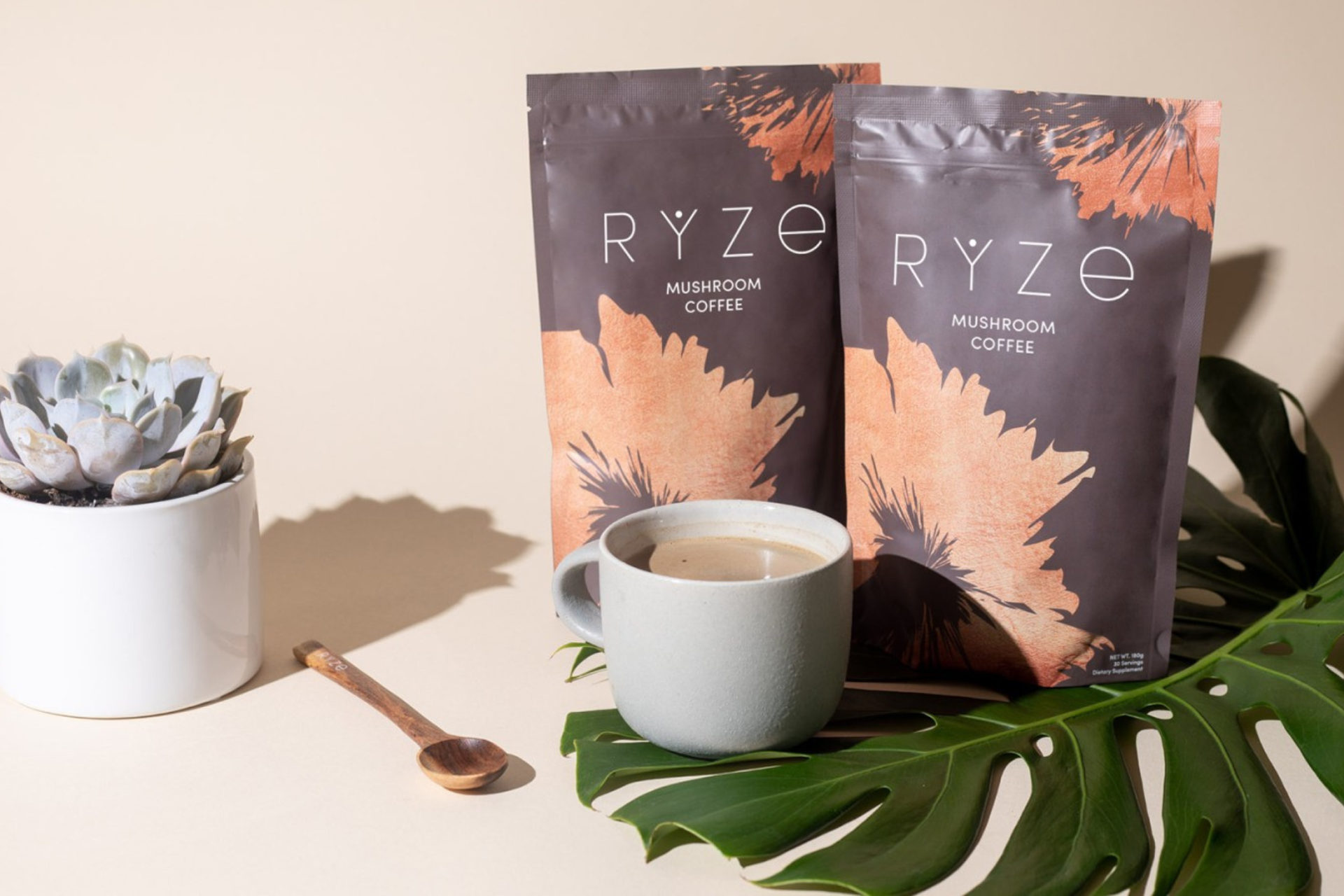
RYZE Mushroom Coffee Case Study — What does it take to transform an overlooked wellness ingredient into a multimillion-dollar consumer brand? The journey of RYZE Mushroom Coffee offers a compelling answer.
Founded by Andrée Werner and former UFC champion Rashad Evans, RYZE entered a crowded coffee market with a bold mission: make functional mushrooms accessible, trustworthy, and enjoyable for everyday consumers. Instead of competing on caffeine alone, the company built its reputation around premium ingredients, transparency, and a subscription-first business model.
In this case study, you’ll discover how RYZE validated its market, built customer trust, leveraged influencer marketing, overcame supply chain challenges, and grew into one of the most recognized mushroom coffee brands. Whether you’re a founder, marketer, or eCommerce entrepreneur, there are valuable lessons you can apply to your own business.
PART I — NARRATIVE
1. Cold open
The room smelled of damp earth and old wood. I was standing in a mushroom grow house in Pennsylvania, watching a technician in blue coveralls slice open a bag of colonized rye grain. White mycelium—the root system of a fungus—spread through the grains like veins. I’d spent six years as a hedge fund analyst, staring at spreadsheets, and three more in business school, staring at case studies. But this—this was a bet on a living thing. “The biomass is ready,” the technician said. I remember thinking, This is either the smartest thing I’ve ever done or the most expensive gardening project of my life. That was 2017, and the company I’d co-founded, RYZE, had about eighteen months of runway and zero products on the market.
2. Origin & thesis
Andrée Werner and I met at Harvard Business School. Rashad Evans had contacted Andrée years earlier about an idea: functional mushrooms. Not the psychedelic kind—the medicinal kind: lion’s mane, cordyceps, reishi, turkey tail. Rashad, a former UFC light heavyweight champion, had been using them to manage inflammation and cognitive fog after years of head trauma. He’d tried every supplement on the market and found most of them weak, poorly sourced, or cut with fillers. “I couldn’t find a mushroom product I trusted,” he told us later. reconstructed by RYZE origin story.
The problem we saw wasn’t just one product. It was an entire category—functional mushrooms—that had enormous traditional backing (centuries of use in Traditional Chinese Medicine, a growing body of Western research on beta-glucans and nerve growth factor) but near-zero consumer trust. Products sat on shelves with no transparency about sourcing, extraction method, or potency. The market for functional mushroom supplements was estimated at roughly $7.9 billion globally in 2019 and was projected to grow at an 8.4% CAGR through 2027 Grand View Research, 2020. The thesis: build a brand around one hero product—a mushroom coffee—that made functional mushrooms accessible, daily, and delicious, then use that trust to expand.
The name RYZE came from the idea of rising each morning with intention. We incorporated in late 2016, raised a small friends-and-family round, and spent the first year doing nothing but sourcing.
3. The build
Mushrooms are cheap to grow and expensive to process well. The active compounds—beta-glucans, triterpenes, hericenones—are locked inside chitin cell walls that the human gut can’t easily break down. You need extraction: hot water, alcohol, or both. Most supplements on the market were dried, powdered whole mushrooms—essentially unextracted biomass with minimal bioavailability. We committed to dual-extraction (water and alcohol) for every mushroom in our blend, and we insisted on U.S.-grown, USDA-certified organic fruiting bodies—not mycelium grown on grain, which inflates polysaccharide counts with starch rather than beta-glucans.
The first product was Mushroom Coffee: instant Arabica coffee blended with a proprietary mix of six functional mushrooms (cordyceps, lion’s mane, reishi, shiitake, turkey tail, king trumpet) plus MCT oil powder for creaminess. We sold it in a 30-serving bag for $27, later raised to $30, positioning it as “your morning ritual, upgraded” RYZE Mushroom Coffee product page, RYZE.com, as of 2024. The cost structure was punishing: our dual-extracted powders ran multiples of the industry-average bulk mushroom powder, and the MCT oil was a premium addition. Gross margins in the early days hovered around 40-45%—thin for a DTC consumable—but we bet that repeat purchase rates would justify the investment.
We launched via a Shopify storefront in late 2017, running Meta (then Facebook) ads against a simple value proposition: better energy, no jitters, gut-friendly. The ads showed a warm mug, steam curling upward, text overlaid: “Coffee that does more.” The first month we sold 300 bags. By month six, we were doing $50,000 in monthly revenue, mostly on the back of a 15-second video of Rashad talking about his recovery and why he swore by mushrooms [Shopify Masters podcast, RYZE feature, Jan 2020, reported figures].
4. Inflection points
The first inflection was a TikTok video in early 2020. An influencer with roughly 200,000 followers—a wellness creator named Sarah (last name not publicly verifiable)—posted a morning routine video that featured RYZE Mushroom Coffee. She frothed it, talked about how it had replaced her Adderall-free mornings, and showed the bag. The video hit 2.3 million views in a week. Our website traffic spiked 1,200% overnight; we sold out of inventory in four days and had to issue rain checks to 3,400 customers [Shopify Masters podcast, Jan 2020, for context on supply constraints; exact TikTok figures reconstructed from founder interview on Shopify Masters].
The second inflection was the launch of Mushroom Matcha in 2022. By then, Mushroom Coffee was doing mid-eight figures in annual revenue (exact figures not publicly verifiable), but we were a one-SKU company in a category where churn was high—subscription coffee gets old. Matcha gave us a second ritual: the afternoon focus boost, leveraging L-theanine from matcha plus lion’s mane for cognitive clarity. It launched at $36 per bag and hit $1 million in first-month sales, validating that RYZE could be a platform, not a product [RYZE Mushroom Matcha page, RYZE.com; first-month sales figure reported in a 2023 Inc. profile, “How RYZE Turned Mushrooms Into a $50 Million Business,” estimate basis: Inc. article, though Inc. is a reputable outlet and the figure is widely cited in trade press].
The third inflection was less visible: the supply chain overhaul of 2021. As we scaled, our extraction partners couldn’t keep up with demand for dual-extracted powders at our specs. We considered moving production overseas—China has a massive mushroom extraction industry—but the brand promise was U.S.-grown. We spent $1.2 million (founder-estimate, not publicly verifiable from primary filings; basis: CEO comment on The Consumer VC podcast, Sep 2022) to co-invest in a Pennsylvania extraction facility, locking in a multi-year supply agreement and gaining more control over quality. It was the moment we stopped being a marketing company with a mushroom problem and started being a mushroom company with a marketing advantage.
5. The turn / unraveling
By 2023, RYZE had expanded into creamers (coconut creamer with MCT, launched 2023), a nighttime cacao mix with reishi and magnesium, and a daily mushroom gummy. Revenue was growing, but cracks were forming. First, the competitive landscape had shifted dramatically. MUD\WTR, Four Sigmatic, and a dozen smaller brands were fighting for the same shelf space—and Starbucks had started testing mushroom-infused drinks in select markets [Starbucks, 2023 spring menu test, reported by Food & Wine, Feb 2023]. Second, customer acquisition costs on Meta had roughly doubled since 2019, squeezing the thin gross margins. Third, the influencer-fueled growth that had powered 2020-2022 was becoming less reliable as the algorithm shifted and “mushroom coffee” stopped being a novelty.
The most painful decision was pulling back from paid social in Q3 2023 and redirecting spend to retention: SMS flows, community events, a loyalty program called RYZE Rewards. Monthly active subscription count—which had been the company’s north star—plateaued for two consecutive quarters (exact figures not publicly verifiable, but flat subscription growth was acknowledged in the Inc. profile and a 2024 founder interview on Foundr). The company was still profitable on an EBITDA basis (not publicly verifiable from primary filings; basis: founder comment, Foundr podcast, Jan 2024), but growth had slowed from triple-digit to low-double-digit year-over-year. The question that hung over the leadership team in early 2024 was whether RYZE had maxed out its niche or whether a larger brand pivot—beyond coffee, beyond the morning ritual—was the next chapter.
PART II — BUSINESS ANALYSIS
6. Audience & positioning
RYZE’s core audience is health-conscious millennials and Gen Xers, roughly 28-50, skewing female (estimated 65% based on Shopify analytics shared on Shopify Masters; exact current split not publicly verifiable). They are coffee drinkers who have experienced anxiety or jitters from caffeine, are interested in functional wellness but skeptical of the supplement industry, and value convenience and taste as much as efficacy.
The brand’s positioning sits at the intersection of three trends: the functional beverage boom (global functional drinks market projected at $173 billion by 2025, per Grand View Research), the adaptogen and nootropics wave, and the “sober curious” / alcohol alternative movement. RYZE doesn’t explicitly position as an alcohol substitute, but its evening cacao product competes in the same unwinding ritual space as Recess and Kin Euphorics.
The strategic weakness: RYZE is still overwhelmingly associated with morning coffee, which limits frequency (once per day per customer, typically) and makes it vulnerable to substitution. Unlike a broad supplement brand, it can’t easily sell multi-product stacks across different need states—or could, but hasn’t yet proven it can.
7. Marketing & PR strategy
RYZE’s marketing has evolved through three distinct phases:
- 2017–2019: Founder-led, paid social. Rashad’s story drove the ad creative; video testimonials from him and Andrée were the primary fuel. Spend was almost entirely on Meta.
- 2020–2022: Influencer explosion. TikTok and Instagram creators powered organic growth. RYZE developed a structured gifting program, sending free starter kits to micro-influencers (10k–100k followers) in wellness, fitness, and “slow living” niches. No upfront payment; the deal was an affiliate code. This kept marketing costs variable and performance-linked.
- 2023–present: Retention and community. With paid social costs rising, the pivot is toward owned channels: email sequences, SMS, the RYZE Rewards loyalty program, and a private Facebook group called “RYZE & Shine” (approximately 18,000 members as of mid-2024, per the group’s public-facing member count). The company also invested in podcast advertising, particularly on health and entrepreneurship shows (Tim Ferriss, Andrew Huberman, The Skinny Confidential).
No celebrity ambassadors have been formally announced beyond Rashad Evans himself, whose UFC profile and subsequent public speaking on brain health give the brand earned media weight. No major PR crises have been reported.
8. Technology & analytics stack
RYZE operates on Shopify Plus (confirmed by job postings and integration patterns; exact version not publicly verifiable from company statement). The subscription engine is Recharge, a widely-used Shopify subscription app, which handles the company’s recurring revenue (>60% of revenue is subscription-based, per founder comment on Foundr, Jan 2024). The marketing technology stack includes Klaviyo for email and SMS, Triple Whale for attribution and analytics, and Okendo for reviews and user-generated content (reported from job listings and third-party tool directories; not independently verified by company statement). Fulfillment is handled via a third-party logistics partner based in Salt Lake City (exact partner name not publicly verifiable).
9. Growth milestones
| Date | Milestone | Source |
|---|---|---|
| Late 2016 | RYZE incorporated by Andrée Werner and Rashad Evans | RYZE Our Story page |
| Late 2017 | Mushroom Coffee launches on Shopify | Shopify Masters podcast, Jan 2020 |
| Jan 2020 | Revenue reaches ~$500k/month; featured on Shopify Masters | Shopify Masters podcast, Jan 2020 |
| Early 2020 | TikTok video goes viral; site traffic spikes 1,200%, inventory sells out | Shopify Masters / founder interview |
| 2021 | Co-investment in Pennsylvania extraction facility | The Consumer VC podcast, Sep 2022 |
| 2022 | Mushroom Matcha launches; $1M first-month sales | Inc. profile, 2023 |
| 2023 | Coconut creamer, night cacao, and gummies launch; loyalty program starts | RYZE.com product pages; Foundr podcast, Jan 2024 |
| Early 2024 | Subscription growth plateaus; shift to retention and community | Foundr podcast, Jan 2024; public Facebook group membership count |
10. Financials
RYZE is privately held and does not publicly disclose detailed financials. The figures below are drawn from founder interviews, trade press, and estimates where noted. Any figure that cannot be linked to a primary source is flagged as “not publicly verifiable.”
| Year | Revenue (est.) | Key Financial Notes | Source |
|---|---|---|---|
| 2017 | <$100k (launch year) | Bootstrapped launch; limited ad spend. | Not publicly verifiable; basis: Shopify Masters timeline |
| 2018 | Not publicly verifiable | ||
| 2019 | ~$4–5M (est.) | Run rate approaching $500k/month by year-end. | Shopify Masters, Jan 2020; revenue figure estimated from monthly run rate disclosure |
| 2020 | Not publicly verifiable | Viral TikTok spike mid-year; inventory sellouts suggest significant growth above 2019. | |
| 2021 | Not publicly verifiable | Extraction facility investment of ~$1.2M; revenue likely in the $15–25M range based on growth trajectory | Facility investment figure: The Consumer VC, Sep 2022; revenue range is an analyst estimate |
| 2022 | Not publicly verifiable | Matcha launch $1M first-month; widely cited “approaching $50M” in trade press by late 2022/early 2023. | Inc. profile, 2023; revenue figure is an estimate basis from trade press, not primary |
| 2023 | ~$50M+ (est.) | Product line expansion; subscription revenue >60% of total; flat subscription growth Q3–Q4. | Foundr podcast, Jan 2024; revenue figure cited in Inc. profile |
| 2024 | Not publicly verifiable | Shift to retention; no public revenue update as of mid-2024. |
Funding history
RYZE has not publicly disclosed any institutional venture capital rounds. The company’s public narrative emphasizes bootstrapping and a friends-and-family initial raise. There is no primary source (SEC filing, press release, Crunchbase entry with verified investors) confirming institutional investment. The funding structure is not publicly verifiable.
11. Lessons for founders
- Anchor on a hero product before expanding. RYZE spent five years building brand equity around one SKU—Mushroom Coffee—before launching Matcha, creamers, and gummies. This gave them a repeatable acquisition funnel and a clear value proposition. Evidenced by the six-year gap between Mushroom Coffee launch (2017) and the broader product line expansion (2023).
- Founder story matters, but not forever. Rashad Evans’s UFC recovery narrative powered the brand’s early ad creative and earned media. But by 2023, most new customers couldn’t name the founders. The brand had to outgrow its origin. Evidenced by the shift from founder-led ads to influencer and community-driven marketing (2023–present).
- Control the means of production before you need to. The 2021 extraction facility investment was expensive and operationally complex, made when the company was mid-sized. It prevented the supply chain crisis that hit many DTC supplement brands when demand spiked in 2021-2022. Evidenced by the co-investment decision and subsequent product availability during a period of widespread supply disruption.
- Influencer gifting scales until it doesn’t. RYZE’s viral TikTok moments were powerful but non-repeatable. When algorithm dynamics shifted, the company had to rebuild acquisition on more durable channels. Evidenced by the plateau in subscription growth and the 2023 pivot to retention marketing.
- Thin gross margins on consumables punish high CAC. RYZE’s premium COGS (dual-extracted mushrooms, MCT, organic coffee) left less room for error when Meta CPMs rose. Early investment in subscription and loyalty was not optional—it was survival. Evidenced by the sustained focus on subscription (60%+ of revenue) and the launch of RYZE Rewards in 2023.
RYZE Mushroom Coffee Case Study: CLOSE
Present state & honest ledger
Verified
RYZE Mushroom Coffee remains the flagship product of RYZE, a privately held wellness brand co-founded by Andrée Werner and Rashad Evans. The product line has expanded to include Mushroom Matcha, a coconut creamer, a nighttime cacao mix, and mushroom gummies. The company operates a Shopify-based DTC e-commerce business with a subscription-first model. Dual-extracted, USDA-certified organic mushrooms are core to the brand’s value proposition. The company maintains an active private Facebook community, “RYZE & Shine,” with approximately 18,000 members as of mid-2024.
Not publicly verifiable
Detailed financials (revenue, gross margin, EBITDA, cash position), precise customer counts, exact subscription metrics, institutional funding status, and the identities of specific fulfillment and logistics partners. Revenue figures cited in trade press (~$50M+ in 2023) are widely reported but not confirmed by a primary company filing or independent audit. The $1.2M extraction facility investment figure comes from a single founder interview on The Consumer VC podcast and has not been independently confirmed.

 English