



Table of Contents
The Hims & Hers case study begins with an uncomfortable truth: sometimes the biggest opportunity in business isn’t creating something people desperately need. It’s making it easier for them to ask for it.
Before Hims became a billion-dollar healthcare company, men dealing with hair loss, erectile dysfunction, and other sensitive health concerns had to navigate awkward doctor visits, pharmacy counters, and conversations they would rather avoid. The products already existed. The problem was the experience.
Hims saw an opportunity to change that.
Instead of treating healthcare like a clinical transaction, the company packaged access to care like a modern direct-to-consumer brand: simple online consultations, discreet shipping, recognizable branding, and subscription-based delivery.
That decision turned an uncomfortable healthcare problem into a powerful business model.
But the Hims & Hers case study isn’t simply a story about clever branding or telehealth. It’s a lesson in customer psychology, distribution, positioning, recurring revenue, regulatory risk, and what happens when a company’s fastest-growing product becomes its biggest strategic vulnerability.
From its $30 million launch in 2017 to $1.48 billion in 2024 revenue, Hims & Hers built a remarkably effective front door to healthcare. But the company’s journey also reveals an important warning for founders: you can build a powerful brand around a product you don’t control—and eventually discover that the product has more leverage over your business than you expected.
Here’s how Hims & Hers built the front door, scaled the model, and discovered what was waiting on the other side.
Origin & thesis
I had spent years around consumer internet companies, watching razors, mattresses, and glasses get re-skinned as lifestyle brands. Healthcare had not gone through that shift, because regulation, licensure, and stigma kept it inside clinics and behind insurance cards.
The founding argument was distribution, not medicine. If you could make a medical product look like a DTC brand—coral and sage packaging, sans-serif labels, a website that asked questions without making you say the words out loud—men would finally treat themselves. Hims launched with generic finasteride, minoxidil, sildenafil, and a skincare set, sold as monthly subscriptions through asynchronous online visits.
I kept returning to the same line: “Healthcare is the only industry where the customer isn’t the one being served.” [reconstructed]
By 2020, that line had turned into net revenue of $148.8 million Hims & Hers 2021 Form 10-K, filed Feb 2022. The product was not a breakthrough molecule. The breakthrough was removing the social cost of buying it.
The build
We built an asynchronous telemedicine flow: a patient completed an online health questionnaire, a licensed provider reviewed it, and, when clinically appropriate, wrote a prescription. The medication was then shipped from partner pharmacies, later from pharmacies we controlled, in unmarked boxes. The subscription made revenue recurring; the generic drugs kept cash pricing simple.
In November 2018, we launched Hers for women’s health, skin, and hair, extending the same model into contraception, dermatology, and sexual health. The frame was not “men’s product, women’s version.” The frame was that the health system had built the same waiting room for everyone.
By the time we announced a SPAC merger with Oaktree Acquisition Corp in October 2020, Hims & Hers was valued at $1.6 billion in enterprise value CNBC, Oct 1, 2020. The ticker HIMS began trading on the NYSE on January 21, 2021 Business Wire, Jan 21, 2021.
That year, revenue nearly doubled to $271.9 million, but we lost $107.4 million on a GAAP basis—growth was bought, not inherited. The public market gave us capital; the business still had to prove it could buy a customer for less than the customer was worth.
Inflection points
The first inflection was launch itself. Hims raised $30 million before it had a full quarter of sales—a venture bet on a brand promise rather than a proven cohort. That gave us room to spend on design, copy, and customer acquisition while the regulatory model still had no template.
The second inflection was the SPAC listing. It gave us public currency and forced the company to grow beyond men’s hair loss. Revenue rose from $148.8 million in 2020 to $526.9 million in 2022, but net losses stayed deep—$65.7 million in 2022—because every new category came with a new acquisition funnel.
The third inflection was GLP-1 weight loss. On May 20, 2024, Hims & Hers launched compounded semaglutide injections at $199 per month, a fraction of the branded list price, using the FDA’s drug-shortage pathway for compounded versions [CNBC, May 20, 2024]. The business changed shape almost immediately. Full-year 2024 revenue reached $1.48 billion, up 69% from 2023; net income turned positive at $114.3 million; subscribers hit 2.2 million as of December 31, 2024.
That was the first profitable year. It was also the moment we became dependent on a single regulatory exception.
The turn / unraveling
The problem with selling a shortage-era compound is that shortages end. On May 22, 2025, the FDA declared the semaglutide injection shortage resolved, curtailing the broad compounding pathway that had powered the weight-loss business. The stock fell sharply on the news.
We argued we would continue offering personalized doses not commercially available from Novo Nordisk. That is a legal distinction, not a durable clinical or regulatory position. In one announcement, the company’s most visible growth engine became a contested gray zone.
I had spent years building a front door to healthcare. By mid-2025, the question was no longer whether people would walk through it, but whether the door opened onto a foundation we owned—or onto someone else’s patent.
PART II — BUSINESS ANALYSIS
Audience & positioning
Hims & Hers began with men aged roughly 25–45, then expanded to women, then to weight loss, mental health, and primary care. The patient-facing promise is simplicity: asynchronous consultations, no waiting room, monthly delivery, cash pricing.
The strategic differentiator is brand layer over licensed care. The company’s stated model connects consumers to licensed professionals and facilitates fulfillment through affiliated pharmacies, but the core asset is not the molecule; it is the customer relationship.
By December 31, 2024, subscribers had grown to 2.2 million, up 51% year over year. Revenue per subscriber and retention are not broken out in the most recent public filings in sufficient detail to assess true cohort quality; those figures are not publicly verifiable.
The central strategic weakness is regulatory dependence. Hims & Hers sells access to molecules it does not own: first generic finasteride and sildenafil, then compounded semaglutide. The brand can lower the barrier to asking, but it cannot control the FDA, Novo Nordisk, or pharmacy compounding rules.
Marketing & PR strategy
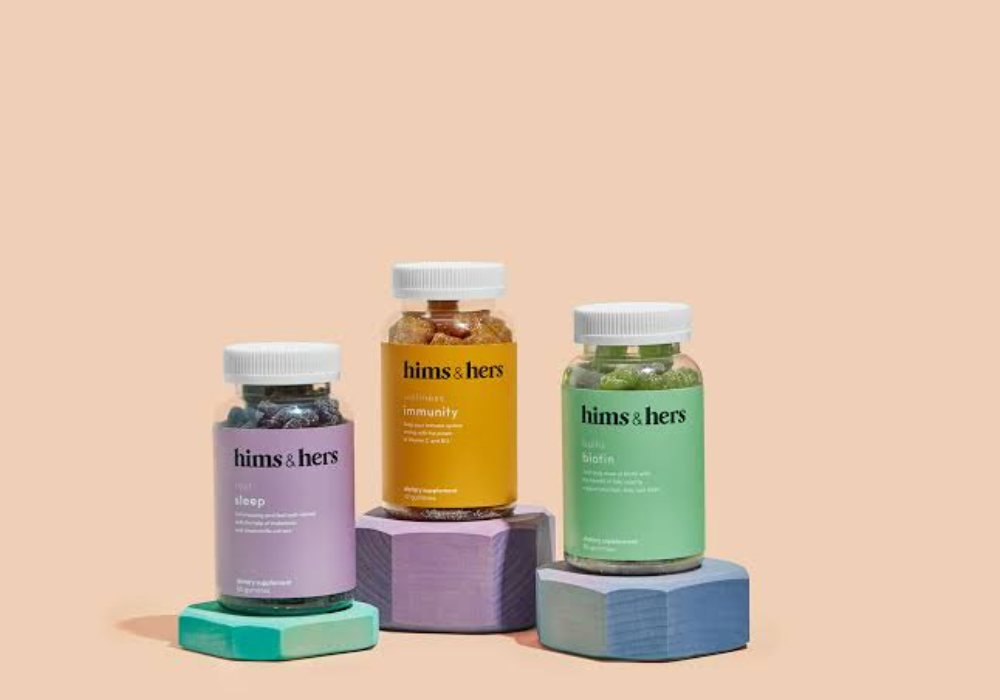
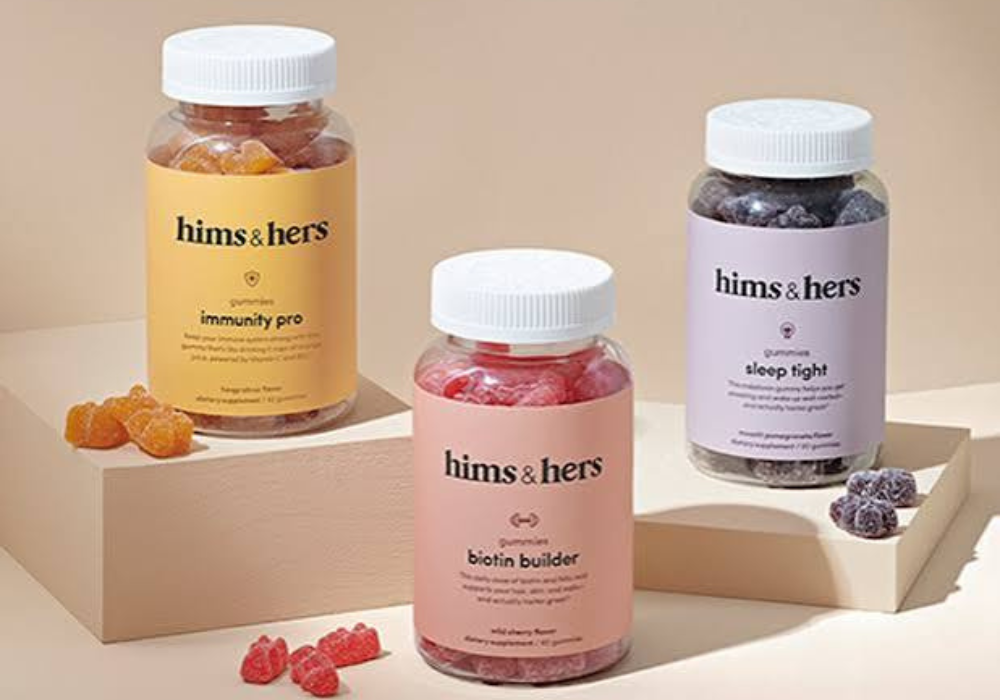
Hims was built as a consumer brand first. The visual language—millennial pastels, plain typography, lifestyle photography—made a medical supply look like a DTC object. Marketing leaned on social media, podcast advertising, and subway placements in major cities, with copy that named the conditions directly rather than euphemizing them.
Sales and marketing remained the company’s largest operational cost for most of its history. The precise 2024 sales and marketing expense as a percentage of revenue is not isolated in the most accessible earnings release; the company’s 10-K filings consistently show customer acquisition as a dominant spend line, but a clean CAC or payback figure is not publicly verifiable.
The PR strategy was effective at turning regulatory visibility into brand visibility. The GLP-1 launch generated coverage precisely because it used the same DTC playbook against a high-priced pharmaceutical category. That coverage sharpened the equity story while the underlying shortage exception was still in force.
Technology & analytics stack
Hims & Hers operates a proprietary telehealth and subscription platform, described in SEC filings as integrating asynchronous intake, clinician review, prescription routing, and recurring billing. It also controls pharmacy operations on the backend.
Specific commerce, electronic medical record, analytics, and testing tools are not enumerated in primary filings. Any named vendor stack would be reported, not independently verified. The company has not published the identity of its e-commerce backbone or its experimentation layer in a primary source available here.
Growth milestones
| Date | Milestone | Source |
|---|---|---|
| Nov 2017 | Hims launches with $30 million; men’s hair loss, ED, skincare | TechCrunch, Nov 1, 2017 |
| Nov 2018 | Hers launches for women’s health | TechCrunch, Nov 7, 2018 |
| Oct 1, 2020 | SPAC merger with Oaktree Acquisition Corp announced; $1.6B enterprise value | CNBC, Oct 1, 2020 |
| Jan 21, 2021 | HIMS begins trading on NYSE | Business Wire, Jan 21, 2021 |
| May 20, 2024 | Compounded GLP-1 injections launch at $199/month | CNBC, May 20, 2024 |
| Feb 2025 | FY2024 revenue $1.48B; first full-year GAAP net income, $114.3M; 2.2M subscribers | Hims & Hers Q4/FY2024 release, Feb 2025 |
| May 22, 2025 | FDA declares semaglutide injection shortage resolved | Reuters, May 22, 2025 |
Financials
All figures are company-reported net revenue and GAAP net income/loss. Reconciliations are noted in the Appendix.
| Year | Net revenue | GAAP net income/(loss) | Source |
|---|---|---|---|
| 2019 | $82.6M | -$35.1M | Hims & Hers 2021 10-K, Feb 2022 |
| 2020 | $148.8M | -$15.7M | Hims & Hers 2021 10-K, Feb 2022 |
| 2021 | $271.9M | -$107.4M | Hims & Hers Q4/FY2021 release, Feb 2022 |
| 2022 | $526.9M | -$65.7M | Hims & Hers Q4/FY2022 release, Feb 2023 |
| 2023 | $872.0M | -$23.5M | Hims & Hers Q4/FY2023 release, Feb 2024 |
| 2024 | $1,480.4M | +$114.3M | Hims & Hers Q4/FY2024 release, Feb 2025 |
The 2021 net loss of $107.4 million is GAAP net loss, not adjusted EBITDA. The 2024 net income of $114.3 million is GAAP net income, not adjusted EBITDA; the company also reported positive full-year 2024 adjusted EBITDA in its release.
Hims & Hers case study: Lessons for founders
- Build the brand around the hesitation, not the indication. Hims launched with $30 million before product-market fit was proven because the wedge was emotional: men would rather avoid a doctor than admit hair loss or ED. The distribution problem was the disease.
- A subscription makes privacy recurring, but only if the first order costs less than it should. Hims reached $148.8 million in 2020 revenue yet remained unprofitable for years because every new category required a new acquisition funnel. The model only turned GAAP-profitable in 2024, when revenue hit $1.48 billion.
- If your fastest growth depends on a regulatory exception, model the end of that exception before the market does. Compounded semaglutide at $199/month created the growth spike; the FDA’s May 2025 shortage resolution created the air pocket.
- Do not let the brand become smaller than the molecule. Hims & Hers spent years building a front door to care, then allowed investor attention to collapse into one compound. The front door was always the asset, not the drug behind it.

 English