
Table of Contents
Sell before you build. It sounds backwards until you see what Gil Hildebrand did with Subscribr.
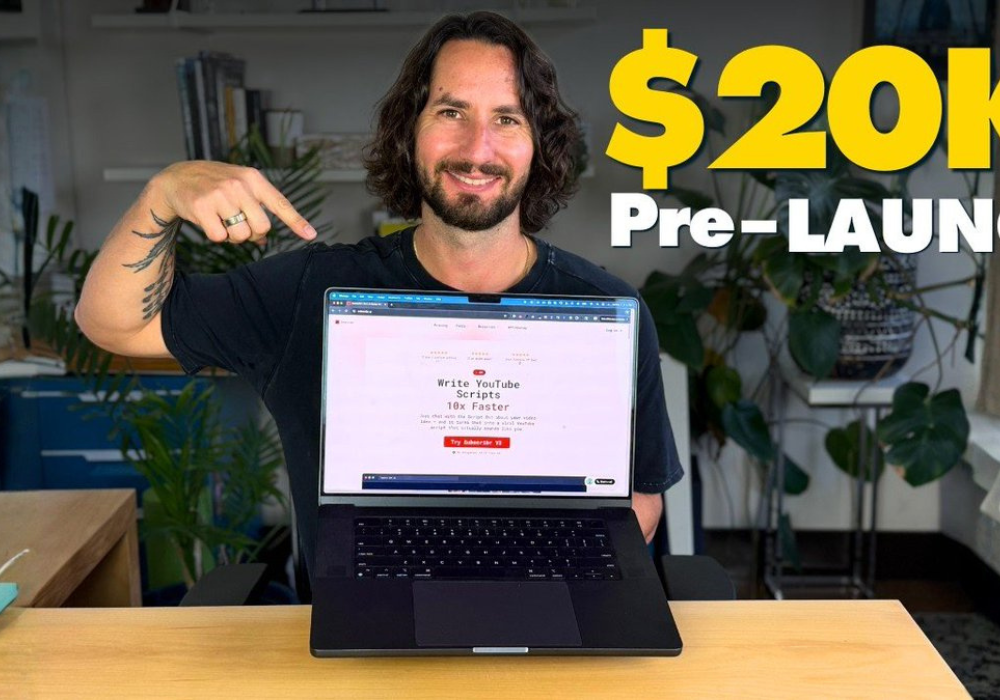
He sold 50 lifetime licenses to software that did not exist yet. The first ten were offered at one price, the next ten at a higher price, and the next ten higher again. The entire batch sold within two to three days and generated roughly $20,000, according to Startup Storys.
The deal came with a 60-day delivery promise, plus a full refund option before delivery and for two weeks afterward. In other words, Hildebrand wasn’t simply collecting money from people who liked the idea. He was creating a financial commitment around a product that still had to earn its way into existence.
That distinction matters.
Hildebrand had already spent months building an audience around the problem he wanted to solve. He analyzed more than 400 YouTube videos, published what he learned, built a free YouTube video analyzer, grew an email list, communicated with potential customers, and spoke directly with people who might eventually buy the product.
Only after that groundwork did he ask people to pay.
His philosophy, recorded in an Indie Hackers interview and reported by Startup Storys, was straightforward: validation comes from paying customers, not from likes or buzz.
Subscribr became a useful case study in what can happen when a founder chooses to sell before building. The pre-sale provided capital, but more importantly, it provided evidence that a specific group of people had a problem they were willing to pay to solve.
This is the part of the story worth studying.
The lesson isn’t simply that founders should launch lifetime deals or copy a $20,000 pre-sale. The more valuable lesson is the sequence that made the pre-sale possible: find the problem, create useful proof, build trust, develop an audience, test willingness to pay, and only then commit significant time and money to the product.
Here’s how Gil Hildebrand did it — and what founders can take from the strategy.
PART I — NARRATIVE
1. Fifty licenses
The offer was fifty lifetime licenses to software that did not exist.
The first ten were cheap. The next ten cost more, and the ten after that more again, so that anyone who hesitated paid for hesitating. The whole batch sold in two to three days and brought in roughly $20,000 (Startup Storys, March 10, 2026, reported). Attached to the money was a promise: delivery in sixty days, with a full refund available any time before delivery and for two weeks after.
[reconstructed] “I hadn’t written a line of it. That was the point. If nobody paid, I’d have saved myself three months.”
The refund window is the part worth pausing on. Twenty thousand dollars that can be clawed back is not really twenty thousand dollars. It is a deadline with a price attached. Gil Hildebrand had spent the previous months giving things away to strangers on X, and this was the moment he asked them to convert — under terms that gave them every exit and left him none.
His position on why is on the record and unusually blunt for a founder describing his own launch: <cite index=”50-1″>validation comes from paying customers, not from likes or buzz</cite> [verbatim] (quoted from Indie Hackers, 2025, via Startup Storys, March 14, 2026, reported).
2. Twenty-five years to the starting line
Hildebrand was 41 and had been writing code professionally for twenty-five years when he launched Subscribr — first job at fifteen in a web development shop, out of college at eighteen because independent consulting was already paying him $50 an hour (Indie Hackers, 2025, founder’s own account). Then Hurricane Katrina took his home in New Orleans (RSAC Conference speaker bio).
Within months he was recruited by Seth Godin as CTO of a new startup called Squidoo, a social publishing platform. He co-founded it in 2005 and stayed nine years, growing it to $10M in revenue (Indie Hackers, 2025, founder’s own account). Squidoo paid roughly half its revenue back to the creators who made content on it, and Hildebrand built the payment rails that pushed <cite index=”37-1″>over $50 million out to users around the world</cite> (The Accountant Quits podcast, on-record interview). Squidoo’s own company materials put the platform at over 2 million visitors a day before it was acquired (Subscribr blog author bio, company-controlled). The acquirer is not named in any source consulted here — not publicly verifiable.
That detail about paying creators is not decoration. It is the same customer twice. The man who spent nine years wiring money to people who make content on the internet later built a company that sells software to people who make content on the internet.
In between came the crypto years. He caught the bug in 2017, sold his BMW for bitcoin, and founded Gilded in early 2018 (RSAC Conference bio) — accounting software for businesses transacting in digital assets, billed as QuickBooks for crypto (Bankless Times, January 31, 2023). He raised $7M from VCs (Subscribr blog author bio, company-controlled) and led it as CEO from 2018 to 2023. Gilded reached $1M ARR before it was acquired (Subscribr About page, founder’s own account).
Then he decided he was done raising money.
[reconstructed] “Seven million dollars buys you a lot of things. Mostly it buys you a calendar full of people you have to explain yourself to.”
3. The bottleneck
After Gilded, Hildebrand went looking for the next problem and got interested in faceless YouTube channels — the format where a team publishes without anyone on camera. He started a channel of his own.
The bottleneck showed up immediately, and it was not editing or thumbnails. It was scripts. His account of the problem on the company’s own About page is a small catalogue of grievances: tight deadlines, mediocre freelance writers, and <cite index=”23-1″>hours spent fooling around with ChatGPT prompts that go nowhere</cite> [verbatim] (Subscribr About page).
The technical insight underneath is that YouTube scripts are structurally unlike prose. They run on information gaps, re-engagement beats, and payoffs timed against a retention curve — and a general-purpose model, asked politely, does not produce that (Startup Storys, March 10, 2026, reported).
He was not a YouTube insider. He was a software builder who had gotten close enough to the workflow to feel the friction, which is a different and often better vantage point than expertise: an insider learns to accept the bottleneck as the cost of doing business.
4. Earning the right to sell
The pre-sale worked because of what preceded it, and the sequence is the actual lesson of this company.
Hildebrand started on X with no followers. His first move was not an announcement. He broke down 400-plus videos from a major YouTube creator to analyze script patterns and published what he found. The thread crossed 80,000 views and roughly doubled his following overnight. He built a free YouTube video analyzer — enter a URL, get a structural breakdown of hooks, CTAs and narrative flow — and gave it away working, not as a waitlist teaser. One post about the video breakdown drove over 100 waitlist signups within days. Over several months he assembled an email list of more than 1,000 people and wrote to them roughly weekly, then did one-on-one conversations with individuals on that list (Startup Storys, March 10, 2026, reported).
Only then did he calculate. He needed about $20,000 to fund roughly three months of building. Fifty buyers at a workable price point got him there. The remaining question was arithmetic: how big does a list have to be to convert fifty buyers at a realistic rate (Startup Storys, March 10, 2026, reported)?
That is the move most founders skip. Not the pre-sale — the eleven months of unpaid, unglamorous work that made a pre-sale possible.
[reconstructed] “Nobody buys from a stranger with a landing page. They buy from the guy who has been useful to them every Tuesday for a year.”
5. Inflection points
April 2024 — the pricing page. Lifetime cash paid for the build but could not sustain the business, so Subscribr launched publicly with recurring pricing (Startup Founder Stories, summarizing the founder’s Indie Hackers account). The company was founded in 2024 (GlobeNewswire press release, August 31, 2026, primary).
~July 2024 — $10K MRR in 100 days. One hundred days from launch to $10,000 in monthly recurring revenue (Indie Hackers, 2025). Selling to people who had already proven they would pay compresses the distance to revenue.
August 2025 — $62K MRR. The founder reported over $62,000 a month and more than $500,000 generated in 2025 with the busy season still ahead (Indie Hackers, 2025, self-reported). See the reconciliation note in the Appendix — this figure and the widely repeated “$30K/month” are not the same measurement.
December 2025 — the second AppSumo campaign, and the review that stung. A fresh wave of lifetime-deal buyers arrived, and with them the most substantive public criticism the product has received. One experienced creator wrote that Subscribr was mostly an AI wrapper with a good-looking workflow, and that users with their own established prompting systems would do better staying in ChatGPT. Hildebrand responded to the review directly (Startup Storys, March 10, 2026, reported; the review text is not independently verified here).
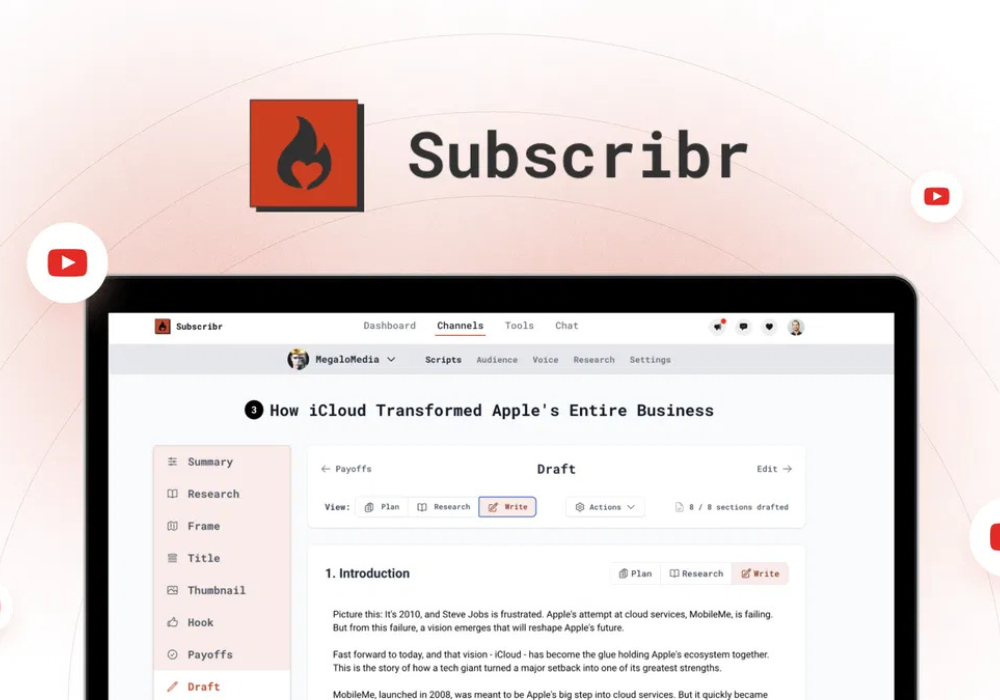
August 31, 2026 — Subscribr 4.0. The company launched a platform that carries a video from research through scripting, thumbnails and finished edit in one workflow, with a 12-step Script Agent, a rebuilt Thumbnail Studio, and Subscribr Video, which returns an edited video within a few hours of a submitted script. Live outlier data draws on more than 35 million YouTube videos. Crucially, agents can drive the entire pipeline through MCP, API and CLI access with no human in the loop (GlobeNewswire, August 31, 2026, primary).
<cite index=”43-1″>”A year ago, no agent had YouTube-specific data or production tools,” said Hildebrand. “Now one can take a project from research to rendered video.”</cite> [verbatim] (GlobeNewswire, August 31, 2026).
6. The wrapper problem
The AI wrapper critique is the central strategic fact of this business, and the company’s answer to it is the entire 2026 roadmap.
A script tool that sits on top of general-purpose models has a shallow moat. Anyone with a good prompt library can approximate it, and the most sophisticated users — the ones who can afford $200 a month — are precisely the ones who already have that library. The critique lands hardest on the customers with the most money and barely registers for beginners, which makes the pricing tier and the value proposition pull in opposite directions.
The stated response, posted on the AppSumo product page, is a change of category: <cite index=”31-1″>Subscribr would be transformed into a platform for YouTube AI agents, so that instead of helping with a script, it goes to work growing the channel</cite> [verbatim, condensed under quotation limits] (AppSumo product page, quoted via Startup Storys, reported).
The August 2026 launch is that promise arriving in product form. An agent that pulls proprietary outlier data across 35 million videos, renders finished video, and exposes the whole pipeline over MCP is meaningfully harder to reproduce with a clever prompt than a script template is. Whether it is hard enough is the open question, and it is not answerable from public information today.
PART II — BUSINESS ANALYSIS
7. Audience and positioning
Subscribr sells to creators who publish consistently — the volume end of YouTube, where scripting is a recurring operational cost rather than an occasional creative act. Pricing runs from $49 to roughly $300 a month depending on tier (Startup Storys, March 10, 2026, reported); new customers currently start from $49 (GlobeNewswire, August 31, 2026, primary).
The differentiator is domain specificity: YouTube-native structure, live outlier research, and voice matching against a creator’s existing catalogue, rather than a general assistant with a YouTube prompt attached. The company reports a 4.8/5 Trustpilot rating (GlobeNewswire, August 31, 2026, company-stated). Net Promoter Score, market share and churn are not published — not publicly verifiable.
The central strategic weakness is the split customer base. Newer creators without a workflow get enormous value and cannot easily afford the upper tiers. Experienced creators can afford them and are the ones most likely to conclude they could rebuild the workflow themselves. Retention data on the lifetime-deal cohorts, which would settle whether the pre-sale predicted durable product-market fit or merely initial willingness to gamble, has never been published — not publicly verifiable.
8. Marketing and acquisition
Three channels, all deliberately low-cost: word of mouth, social media, and programmatic SEO, the last producing over 30,000 organic visits a month from structured pages built to target many searches at once (Startup Storys, March 10, 2026, reported). Paid ads run at roughly $2,000 a month — small, and clearly not the engine. An affiliate program and early X giveaways supplemented the passive channels (Startup Founder Stories).
The X account grew from zero to a modest but tightly targeted following — 5,818 as of March 2026 (Startup Storys, March 10, 2026, reported). This is worth dwelling on: a business generating six figures a year was built on an audience smaller than many failed newsletters. Precision beat scale.
AppSumo functioned as a second, distinct acquisition channel, running at least two lifetime-deal campaigns (AppSumo product page). Lifetime deals trade future recurring revenue for present cash and a review corpus — useful for a bootstrapper who needs runway now, expensive if the cohort churns.
Build-in-public content on Indie Hackers and X did double duty as marketing. The Indie Hackers post is simultaneously the most detailed record of the company’s finances and its most effective piece of top-of-funnel content.
9. Technology and cost structure
The stack is deliberately unfashionable: a Laravel (PHP) application on DigitalOcean, run early on from a single droplet (Startup Founder Stories; corroborated by note.com, April 27, 2026). Roughly 90% of the code is written by an AI coding assistant, with the founder’s role shifted to design, decisions and direction (note.com, April 27, 2026). The legal entity is Supercharger Studio, Inc. (Toolify listing, reported, not independently verified).
The economics are the interesting part. AI inference is the single largest operating cost — around $3,500 a month across multiple model providers, exceeding hosting and labour (note.com, April 27, 2026).
| Cost category | Approx. monthly | Notes |
|---|---|---|
| AI compute | ~$3,500 | Across multiple model providers |
| Paid ads | ~$2,000 | Small relative to organic |
| Other tools | ~$1,500 | Scraping, DigitalOcean hosting, email |
| Total | ~$7,000 |
Source: Startup Storys, March 10, 2026, reported; AI compute figure corroborated by note.com. Figures are approximate and self-reported.
This is the structural point that generalizes beyond Subscribr: every additional customer carries a marginal inference cost, so AI SaaS does not enjoy the near-zero marginal cost of traditional software. That is why the entry price is $49 rather than $9 (Startup Storys, March 10, 2026, reported). Price on value of time saved, or the margin evaporates before scale can rescue it.
10. Timeline
| Date | Milestone | Source tier |
|---|---|---|
| 2005 | Co-founds Squidoo with Seth Godin; nine years, $10M revenue | Founder’s own account (Indie Hackers) |
| ~2014 | Squidoo acquired; acquirer not publicly verifiable here | Company-controlled bio |
| 2014–2020 | Runs Supercharger Studio; clients include NYCEDC, Entergy | Company-controlled bio |
| 2017 | Enters crypto after a New Orleans Ethereum meetup | Speaker bio / reported |
| 2018–2023 | Founds and leads Gilded as CEO; raises $7M; reaches $1M ARR; acquired | Company-controlled bio + About page |
| Early 2024 | Pre-sells 50 lifetime licenses in 2–3 days for ~$20K | Reported |
| April 2024 | Public launch with recurring pricing | Reported, summarizing founder account |
| ~July 2024 | $10K MRR, 100 days post-launch | Founder’s own account (Indie Hackers) |
| August 2025 | $62K MRR reported; $500K+ generated in 2025 | Founder’s own account, self-reported |
| December 2025 | Second AppSumo campaign; “AI wrapper” critique surfaces | Reported |
| March 2026 | ~4,000+ customers; ~$30K/month subscription revenue | Reported |
| August 31, 2026 | Subscribr 4.0 launch; 5,000+ users; Bryan Ng named co-founder | Primary (GlobeNewswire) |
11. Financials
| Metric | Figure | As of | Source & scope |
|---|---|---|---|
| Pre-launch revenue | ~$20,000 | Early 2024 | Reported; 50 lifetime licenses, refundable |
| MRR | $10,000 | ~July 2024 | Founder account; 100 days post-launch |
| MRR | $62,000+ | August 2025 | Founder self-reported, Indie Hackers |
| 2025 revenue | $500,000+ | August 2025, YTD | Founder self-reported, busy season pending |
| Monthly subscription revenue | ~$30,000 | March 2026 | Reported; subscription only — see Appendix (a) |
| Customers | 4,000+ | Mid-2025–March 2026 | Reported, paying customers |
| Users | 5,000+ | August 2026 | Primary; “used by,” not stated as paying |
| Monthly operating costs | ~$7,000 | March 2026 | Reported, approximate |
| Outside funding | $0 | Current | Bootstrapped; no raise reported |
| Valuation | Not publicly verifiable | — | No disclosed round or transaction |
| Churn / retention | Not publicly verifiable | — | Never published |
The $1M question. Widely repeated as achieved; it is not. Hildebrand’s own framing in August 2025 was that he was <cite index=”49-1″>pushing for $1M revenue in year 2</cite> [verbatim] (X, August 27, 2025) — a target. In December 2025 the language was “on track for.” Secondary write-ups subsequently converted a trajectory into a milestone. Treat $1M as a stated goal with a credible run-rate behind it, not a verified result. See Appendix (a).
Sell Before You Build: Lessons for founders
- Sequence beats tactic. The $20K pre-sale is the copied part and the least important. It rested on a 400-video public teardown, a free working analyzer, a 1,000-person list, weekly emails and one-on-one calls. Copy the eleven months, not the seven days.
- Make validation arithmetic, not emotion. He worked backward: $20K needed, 50 buyers, therefore a list of size X at conversion rate Y. That converts a feeling into a solvable problem.
- Price against your marginal cost, not against your category. At ~$3,500/month in inference, a $9 tier would have been fatal. The $49 floor is a margin decision disguised as a positioning one.
- A refund window is a feature, for both sides. It de-risked the buyer and imposed a real deadline on the builder. Cash you can lose concentrates the mind more than cash you cannot.
- A small precise audience outperforms a large vague one. Under 6,000 followers supported a business at this scale because every follower was the customer.
- Take the harshest review seriously and answer it in product, not in comments. The wrapper critique was answered with proprietary data, rendering infrastructure and agent access — a category change, not a rebuttal.
- Bootstrapping is a constraint you choose after you have priced the alternative. He raised $7M once and declined to do it again with full knowledge of both games.
CLOSE — Present state and honest ledger
Verified. Founded 2024, New Orleans. Two named co-founders as of August 2026: Gil Hildebrand and Bryan Ng. Bootstrapped, no outside funding reported. Product spans research, scripting, thumbnails and video production, with agent access via MCP, API and CLI. Outlier data covers 35M+ YouTube videos. 5,000+ users. Entry pricing from $49. Company-stated Trustpilot rating of 4.8/5. Prior founder track record — Squidoo, Supercharger Studio, Gilded ($7M raised, $1M ARR, acquired) — is consistently documented across independent sources.
Not publicly verifiable. Current MRR or ARR as of September 2026. Whether $1M annual revenue was achieved rather than approached. Churn and retention, including the lifetime-deal cohorts. Paying-customer count today, as distinct from the 5,000+ “used by” figure. Gross margin at current scale. Squidoo’s acquirer. Bryan Ng’s equity position or the date his role became co-founder. Any valuation.

 English